18:02 Factors Affecting The Weight a Column Can Withstand | |
|
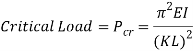
Matthew Keeley Physics EEI This extended experimental investigation explores the weight a paper column can withstand before it buckles and how changing the diameter, length and thickness of a column affects its critical load. Multiple columns with varying diameters, lengths and thicknesses were constructed and each one had masses added to it until it buckled. The hypotheses “If the diameter of a paper column is increased, then the weight the paper column can withstand before buckling will also increase exponentially” and “If the length of a paper column is decreased, then the weight the paper column can withstand before buckling will increase exponentially” were not supported while the hypothesis “If the thickness of a paper column is increased, then the weight the paper column can withstand will also increase proportionally” was supported, casinospel utan licens. Get Help With Your Essay If you need assistance with writing your essay, our professional essay writing service is here to help! Columns are used in architecture and structural engineering, in the walls of houses and buildings, to transmit weight through compression from the structure above the column to the structural elements beneath (Merriam-webster.com, 2017). Objects are only referred to as columns when the force is applied axially; they are referred to as beams otherwise (Waddell, 1925). Column buckling is likely the only area of structural mechanics where failure is not due to the strength of the material, but the stiffness of the material and the shape of the column instead (McGinty, 2017). Buckling occurs in a column when its critical load is reached and this value can be determined by the Euler column formula, which is as follows:
Where This formula is used mainly to calculate the buckling load of steel and wooden columns so its application in the buckling of paper columns is questionable although it is the only method available. There are some unknown values in the equation without researching them using other sources, the The
A relationship known as Hooke’s Law, Hooke’s law states that the strain in a solid is proportional to the applied stress within the elastic limit of that solid (Encyclopedia Britannica, 2017). For example, if an object with a high modulus of elasticity had the same force applied to it as an object with a low modulus of elasticity there would be a greater change in dimension in the object with the smaller modulus of elasticity. The modulus of elasticity is represented in pascals (
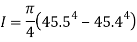
The formula for second moment of area for a hollow cylindrical cross-section is as follows:
Where
Then the formulae for second moment of area are as follows:
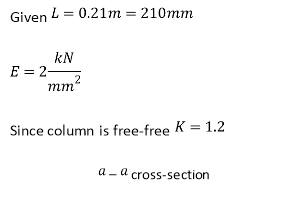
One would have to solve for both The last unknown value is For this experiment to be a success many variables must be remain the same that were quite difficult to control. To attempt to control these variables some precautions were taken. For example, to keep the distribution of weight the same a transparent board was used so the weight could be placed in the centre of the column and distributed evenly. Also, the paper columns need to be made carefully so that there are no weaknesses in the column because weaknesses in the column aren’t factored into Euler’s column formula. The dimensions for paper are 29.7mm x 21mm x 0.1mm (for 80gsm A4 paper). Theoretical Data
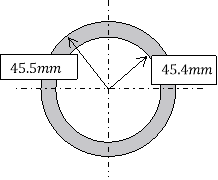
Calculating second moment of area (
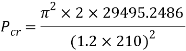
Substituting into Euler’s column formula and solving to find critical load.
Calculating the mass the column could withstand using
This value is very large and a paper column of the dimension used in the calculations would certainly crumble under this amount of force in real life applications, but this may be due to all the other variables that are difficult to control at play, such as weaknesses in the column geometrically and weight distribution rather than the formula being incorrect. | |
|
|
|

 is the critical load (
 ),
),  is the modulus of elasticity (
 ),
),  is the area moment of inertia (
 ,
,  is the length of the column (
 ) and
) and  is the column effective length factor (Engineeringtoolbox.com, 2017). Engineers commonly use mm instead of regular SI unit, examples of the formula being used use mm (Critical Buckling Load (Example 1) – Mechanics of Materials, 2013).
 ) but the value is usually very large so it is found in gigapascals instead (
 . When calculating theoretical data to keep the units the same the modulus of elasticity was represented in
  as
as . The modulus of elasticity for paper is 2
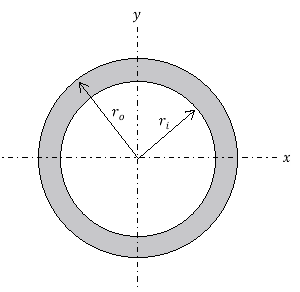 The
The 
 is the radius of the outside circle and
  is the radius of the inside circle (Efunda.com, 2017).
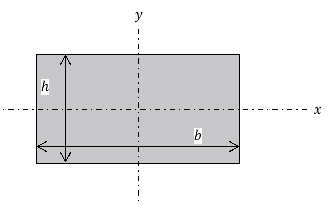 The second moment of area also determines the way a column is most likely to buckle (towards the
  plane or the
  plane). Usually there would be multiple formulae for the second moment of area, one for buckling towards the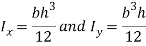
 and
and  and find out on which plane the column is most likely to buckle along and use that value as the second moment of area in the Euler column formula (What is second moment of area?, 2015). The units for second moment of area are metres to the fourth power (
 , but since the units need to be kept the same and the radius will be represented in millimetres when doing theoretical data, it will be in millimetres to the fourth power (
 ) instead.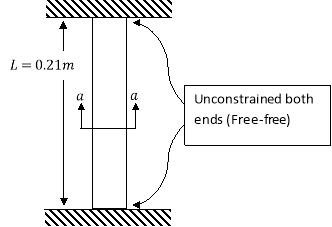





 .
.


| Всего комментариев: 0 | |